Proving the Doubters Wrong: Pit Bulls Are Quietly Revolutionizing Therapy Animal Programs Across America
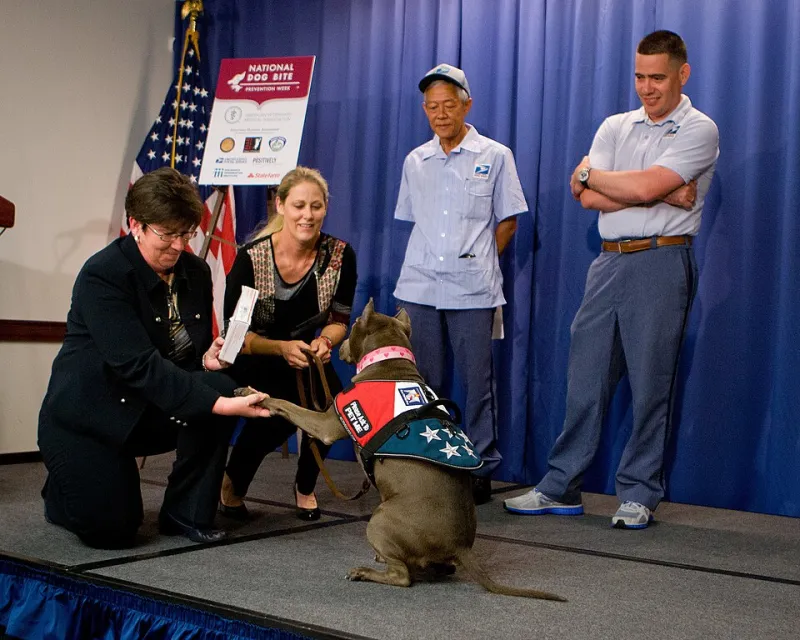
Photo: State Farm, CC BY 2.0, via Wikimedia Commons
The Dog Nobody Expected to Help
When Marine veteran Carlos Mendez first walked into a PTSD support group in San Diego, he wasn't expecting much. He'd tried talk therapy. He'd tried medication. What he hadn't tried was a stocky, brindle-coated pit bull named Rosie pressing her head into his lap like she'd known him for years.
"She just... got it," Carlos says. "I don't know how else to explain it. She didn't need me to talk. She didn't need me to perform being okay. She just sat there, and somehow that made everything quieter."
Rosie is a certified therapy dog working with a San Diego-based veterans' wellness nonprofit. She was pulled from a municipal shelter at age two, evaluated for temperament, and trained over several months before earning her Canine Good Citizen certification through the American Kennel Club — the gold standard entry point for therapy animal work. She is also, unmistakably, a pit bull.
And she is far from alone.
What the Research Actually Says About Pit Bull Temperament
For decades, the narrative around pit bulls has been shaped more by fear than by data. But researchers and animal behaviorists have been quietly building a very different picture.
The American Temperament Test Society (ATTS) has consistently found that American Pit Bull Terriers pass their standardized temperament evaluations at rates comparable to — and often exceeding — many popular family breeds. In recent testing cycles, pit bull-type dogs scored passing rates in the high 80th percentile range, outperforming breeds like Chihuahuas and Collies.
Dr. Lisa Radosta, a board-certified veterinary behaviorist based in Florida, puts it plainly: "There is no scientific basis for classifying pit bulls as inherently dangerous or unsuitable for therapeutic work. What we see in temperament testing and in clinical settings is a dog that is highly people-oriented, emotionally attuned, and responsive to training. Those are exactly the traits you want in a therapy animal."
That emotional attunement — the same quality that made Rosie so effective with Carlos — is something handlers and trainers describe again and again. Pit bulls tend to be deeply bonded to humans, highly motivated by social interaction, and sensitive to shifts in mood. In therapeutic settings, those traits aren't liabilities. They're superpowers.
From Shelters to Schools: Organizations Leading the Way
Across the US, a growing number of nonprofits and programs are putting that science into practice — and getting remarkable results.
Pits for Patriots, based in New Jersey, has been matching pit bull-type dogs with veterans experiencing PTSD since 2012. Their model involves rescuing dogs from shelters, running them through an intensive behavioral assessment, and pairing them with veterans who participate in the training process itself. The dual-rehabilitation approach — healing human and dog together — has become something of a blueprint for similar programs nationwide.
In Chicago, PAWS Chicago has partnered with local schools to bring certified therapy dogs, including several pit bull mixes, into classrooms as part of literacy programs. Kids who struggle to read aloud to adults or peers will often read confidently to a dog. There's no judgment, no impatience, no red pen. Several of the program's most popular canine volunteers are pit bulls — beloved by students who, in many cases, had been told their whole lives these dogs were something to fear.
Out west, The Linden Tree Foundation in Los Angeles runs community healing circles for survivors of domestic violence and sexual assault. Their therapy dog roster includes three pit bulls, all rescues, all certified. Program director Maya Okafor says the response from participants has been overwhelming.
"A lot of our clients have complicated relationships with trust," she explains. "When they meet one of our dogs — a dog that everyone told them was scary — and they feel safe, something shifts. It's almost like a metaphor they can hold onto. Things aren't always what the world tells you they are."
The Certification Process: Rigorous, Breed-Blind, and Merit-Based
It's worth understanding just how demanding the path to therapy dog certification actually is. Organizations like Pet Partners and the Alliance of Therapy Dogs require dogs to demonstrate rock-solid temperament under pressure — unexpected noises, medical equipment, crowds, people in distress. Handlers must also complete training and pass evaluations.
There is no shortcut. There is no special dispensation. Every dog that earns certification earns it on merit.
That's kind of the whole point for us here at The Merit Pit Bull Foundation. Merit. Not breed. Not reputation. Not what someone read in a tabloid headline fifteen years ago. What a dog can actually do, how they actually behave, and who they actually are.
Pit bulls who make it through these programs do so because they're good at the work — full stop.
Changing the Story, One Visit at a Time
The ripple effects of therapy pit bulls extend well beyond the individuals they directly serve. Every time a pit bull walks calmly through a hospital ward, sits patiently while a child reads, or grounds a veteran in the middle of a flashback, they're rewriting a story that's done enormous damage — to the breed, to shelters overflowing with these dogs, and to the families who've loved them.
Handlers like Denise Thornton, who volunteers with her pit bull mix, Duke, at a Cincinnati children's hospital, see it in real time. "The nurses used to do a double-take when we walked in," she laughs. "Now they're the ones who request us specifically. The kids ask for Duke by name. That's not nothing. That's everything."
The therapy animal world isn't without its challenges for pit bull advocates. Some hospital systems and care facilities still maintain breed restrictions that exclude pit bulls regardless of certification. It's a frustrating reality — one that mirrors the broader fight against breed-specific legislation — and it's something advocates are actively pushing back on, armed with exactly the kind of evidence these programs generate.
But the momentum is real. The certifications are real. And the healing — for veterans, for kids, for survivors, for the dogs themselves — is absolutely real.
If you're interested in supporting pit bull therapy programs in your area, check out our resources page for a directory of organizations doing this work across the US. And if you have a pit bull you think might have what it takes, talk to a certified trainer about starting the Canine Good Citizen evaluation process. Merit is earned. Let's help more dogs earn it.