Graded on Behavior, Not Bloodline: The Shelter Experiment That Deleted Breed From the Clipboard
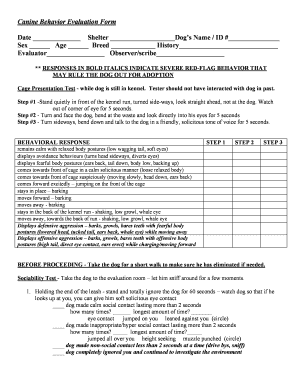
Photo: shelter worker evaluating dog behavior assessment kennel, via www.pdffiller.com
There's a clipboard hanging by the intake desk at a mid-sized shelter outside Dayton, Ohio, and for the past year it has carried exactly zero references to breed. Not on the kennel cards. Not on the website listings. Not in the adoption files.
Instead, every dog that walks through the doors gets the same thing: a standardized behavioral evaluation, scored on a rubric the staff calls — half-jokingly at first, then not — the merit test.
The premise is almost embarrassingly simple. If you want to know whether a dog will thrive in a home, watch the dog. Not the paperwork. Not the guess some intake volunteer made about what's "in the mix." The dog.
What the Merit Test Actually Measures
The evaluation breaks down into a handful of observable categories: how a dog responds to a stranger approaching the kennel, how it handles handling (literally — paws, ears, mouth, collar grip), its reaction to another dog passing at a controlled distance, food-bowl behavior, and recovery speed after a startle. Each is scored on a simple scale, and the composite becomes the dog's public profile.
A nervous dog who flattens at loud noises but leans into human touch gets described that way — "startles at sudden sound, recovers in under ten seconds, seeks contact" — instead of a breed name that invites adopters to fill in the blanks with whatever a TV movie taught them.
The staff didn't invent the idea from scratch. Behaviorists have argued for decades that breed labels on mixed-breed dogs are unreliable anyway; DNA studies routinely show shelter staff guesses miss the mark more often than they hit it. What's new here is treating that fact as policy rather than trivia.
What Changed When the Labels Went Away
The numbers, a year in, are hard to argue with. Average length of stay for the dogs most commonly labeled pit mixes dropped noticeably. Adoption inquiries for those same dogs went up — not because the dogs changed, but because the descriptions did. Adopters who would have scrolled past a "pit mix" were reading "confident, food-motivated, loves fetch, pulls on leash" and deciding that dog sounded like their dog.
Returns went down, too, and that might be the more important figure. When adopters selected a dog based on observed behavior matched to their lifestyle — a jogger picking a high-energy scorer, a quiet household picking a mellow one — the match held. Nobody adopted a dog expecting one personality and met another at the door.
And yes, a healthy share of the dogs scoring highest on sociability and handler-friendliness were the blocky-headed, broad-chested dogs America loves to fear. Anyone who's spent time in shelters won't be surprised. Everyone else might be.
The Skeptics Showed Up, As Skeptics Do
Not everyone in the welfare world is ready to hand out gold stars. Critics within the animal welfare community raise fair points. Standardized tests are snapshots, not prophecies — a dog can bomb a kennel-front assessment because of the environment and be a dream at home, or ace it and struggle later. Some researchers have spent years warning that shelter evaluations predict shelter behavior, not necessarily living-room behavior.
The Dayton-area program's answer is that the merit test was never meant to be a verdict. It's a data point, paired with foster observations and honest conversations with adopters. The alternative — a breed guess with a documented error rate — isn't a data point at all. It's a horoscope.
There's also the objection that hiding breed is a bait-and-switch: adopters deserve to know what they're getting. But when the "what" is a guess, nobody's being deceived by describing what a dog actually does. You can't bait-and-switch with the truth.
Why This Matters Beyond One Shelter in Ohio
Shelters across the country are quietly watching experiments like this one, because the stakes are enormous. Blocky-headed dogs — labeled pit bulls whether or not the label fits — make up a disproportionate share of shelter populations and an even more disproportionate share of euthanasias. Anything that moves the needle on their length of stay moves the needle on lives.
The deeper shift, though, is philosophical. A merit-based system says the individual in front of you is the story. Not the label. Not the rumor. Not the headline from a town you've never been to.
That's the same principle this foundation was built on. We've watched pit bulls pass temperament tests at rates that should end the debate, watched them ace therapy work and dock dives and living-room nap duty. The merit test just writes down what the rest of us already knew: judge the dog on the dog.
The clipboard in Ohio doesn't have a breed column. Turns out it never needed one.